
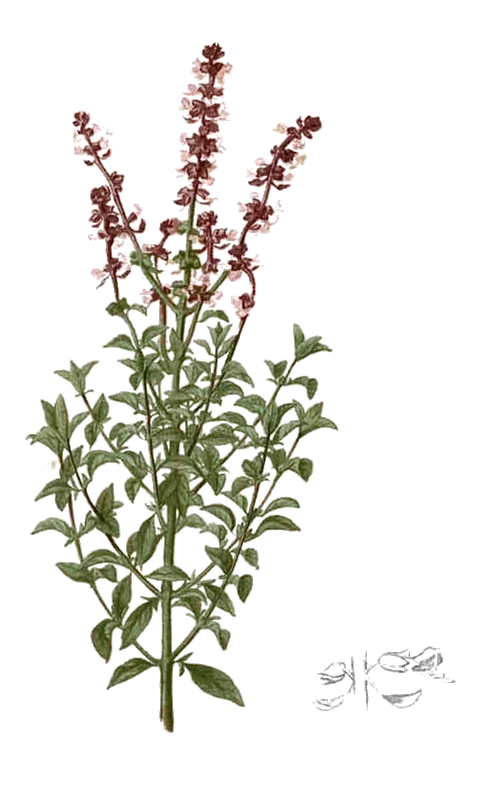
Sweet, herbal, green. The terpene that makes a strain smell like a windowsill in summer.
Worth knowing
A green-floral note across mint, basil, parsley, and hops; a plant defense compound, which is why it’s everywhere in the herb garden.
Did you know?
Ocimene is named after Ocimum, basil. Patients describe its strains as ‘lighter’: less peppery, less sharp, less foggy than the big three.
How it tends to land
Commonly reported as light and clear. Tendencies, not promises. Your body writes the last word.
Pairs well with
Examined for these conditions
No condition has research pointing specifically to this terpene yet. Browse all conditions
Where the evidence stands
Ranked by how much each finding can actually tell you, strongest first. A trial in people outranks a study in cells, including when the answer is no.
Animal studies
Anti-inflammatory activity
Reduced swelling and several inflammatory signals in a rat arthritis model. Laraib I, Qasim S, Uttra AM, et al. (2025). Inflammopharmacology. PubMed 40266533
Cell studies
Antifungal activity in the lab
Tested cis-β-ocimene as an isolated compound rather than as part of a whole oil, which is what makes it usable evidence about ocimene itself. Cavaleiro C, Salgueiro L, Gonçalves MJ, et al. (2015). Journal of Natural Medicines, 69(2). PubMed 25576097
No published study · still open
Acting as a decongestant
Frequently listed as one. We could not find a human study supporting it.
Chemical identity, formula and molar mass: PubChem CID 18756, National Center for Biotechnology Information.
Terpenology is educational, not medical advice. Terpene effects are tendencies commonly reported by patients and early research, never guaranteed outcomes. Work with your certifying physician and pharmacist.