
Earthy, ripe, sedating. The reason a heavy chemovar feels heavy.
Worth knowing
The most abundant terpene in cannabis. Strains people call heavy often run high in myrcene, though the exact 0.5% cutoff is a testing-lab rule of thumb, not a human study.
Did you know?
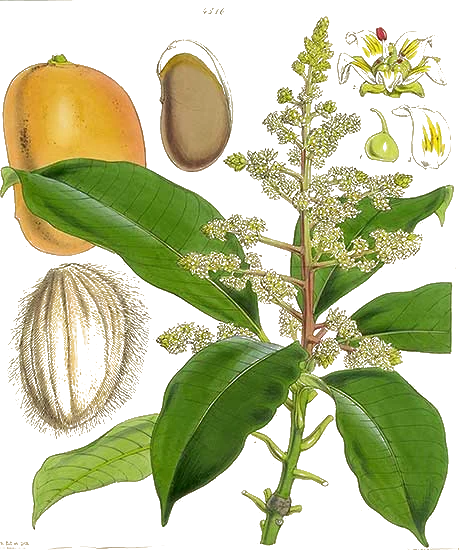
You may hear that eating a mango before you consume boosts your high through its myrcene. The dose does not add up: a whole mango carries a tiny fraction of the myrcene in a small amount of flower. A fun story, not a real effect.
How it tends to land
Commonly reported as heavy and deeply relaxed. Tendencies, not promises. Your body writes the last word.
Pairs well with
Examined for these conditions
Chronic Pain/Diabetes/Fibromyalgia/Neuropathic Pain/Perimenopause/Rheumatoid Arthritis / See all conditions
Where the evidence stands
Ranked by how much each finding can actually tell you, strongest first. A trial in people outranks a study in cells, including when the answer is no.
Animal studies
Sedative and muscle-relaxant effects
Mice moved, reared and groomed less, showed muscle relaxation on the rotating-rod test, and slept about 2.6 times longer under a sedative. This is the body-heaviness people describe, showing up independently of any cannabinoid. do Vale TG, Furtado EC, Santos JG Jr, et al. (2002). Phytomedicine, 9(8):709–714. PubMed 12587690
Animal studies · not established
Calming anxiety
The same study that shows myrcene's sedative effect measured anxiety separately and found the opposite: slightly anxiogenic at higher doses. Heavy and calm are two different things, and myrcene is the first one. PubMed 12587690
No published study · still open
Helping cannabinoids cross into the brain
One of the most repeated claims in cannabis writing. We could not find published research measuring myrcene's effect on the blood-brain barrier in any model.
Chemical identity, formula and molar mass: PubChem CID 31253, National Center for Biotechnology Information.
Terpenology is educational, not medical advice. Terpene effects are tendencies commonly reported by patients and early research, never guaranteed outcomes. Work with your certifying physician and pharmacist.