
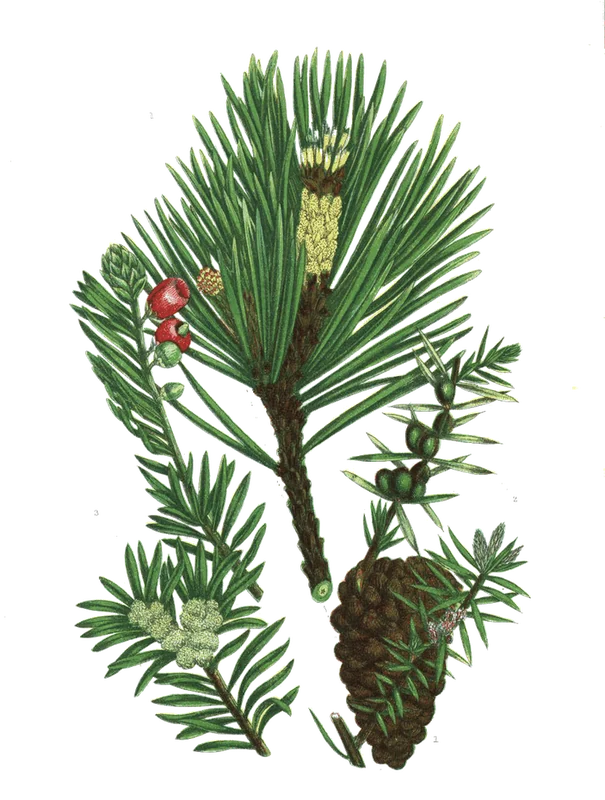
Crisp, piney, alerting. The reason your head stays yours.
Worth knowing
The most abundant terpene in nature, and the one your nose knows best. In people, about 60% of inhaled alpha-pinene is taken up through the lungs, and it lingers in fatty tissue.
Did you know?
Pinene was long thought to protect short-term memory from high-THC cannabis. A 2025 human trial tested that directly and found it did not. The clear-headed reputation many people describe is real; the memory-protection claim is one we retired.
How it tends to land
Commonly reported as clear-headed and alert. Tendencies, not promises. Your body writes the last word.
Pairs well with
Examined for these conditions
Where the evidence stands
Ranked by how much each finding can actually tell you, strongest first. A trial in people outranks a study in cells, including when the answer is no.
Human trial · not established
Protecting short-term memory from high-THC cannabis
Tested directly in people. Added α-pinene did not reduce THC memory impairment, or change any other acute effect. A clean answer to a question worth asking. Kumar L, Spindle TR, Zamarripa CA, et al. (2025). Medical Cannabis and Cannabinoids. PubMed 40734690
Human study
Efficiently absorbed through the lungs
About 60% pulmonary uptake, with a long half-life in fatty tissue. The same study found no acute change in lung function, and a dose-related irritation signal in five subjects. Falk AA, Hagberg MT, Löf AE, et al. (1990). Scandinavian Journal of Work, Environment & Health, 16(5):372–378. PubMed 2255878
Animal studies
Anti-inflammatory activity
Reduced inflammatory and oxidative markers in a rat arthritis model. Note the site: this is systemic inflammation in joints, not an airway effect. Ali K, Iqral, Sharif A, et al. (2026). Inflammopharmacology, 34(5):3293–3312. PubMed 41888386
Cell studies
Antifungal activity in the lab
Tested α-pinene as an isolated compound, not just as part of a whole oil. Active against dermatophytes and Cryptococcus. Cavaleiro C, Salgueiro L, Gonçalves MJ, et al. (2015). Journal of Natural Medicines, 69(2). PubMed 25576097
Cell studies
Inhibits acetylcholinesterase in the lab
Both mirror-image forms of α-pinene were potent inhibitors of the enzyme that clears acetylcholine, the signal tied to attention and memory. This is the real mechanism behind pinene's clear-headed reputation, and it is measured in an enzyme assay, not in a person. When that idea was finally tested in people (see above), the memory benefit did not appear. A mechanism that does not translate is one of the most common stories in pharmacology. Miyazawa M, Yamafuji C. (2005). Journal of Agricultural and Food Chemistry, 53(5):1765–1768. PubMed 15740071
No published study · still open
Opening the airways (bronchodilation)
Widely repeated, including here until July 2026. We could not find a published study demonstrating it. The human inhalation study usually cited measured uptake, not airway effects, and reported no acute change in lung function. PubMed 2255878
Chemical identity, formula and molar mass: PubChem CID 6654, National Center for Biotechnology Information.
Terpenology is educational, not medical advice. Terpene effects are tendencies commonly reported by patients and early research, never guaranteed outcomes. Work with your certifying physician and pharmacist.