
Earthy, hoppy, grounding. The terpene cannabis and beer have in common.
Worth knowing
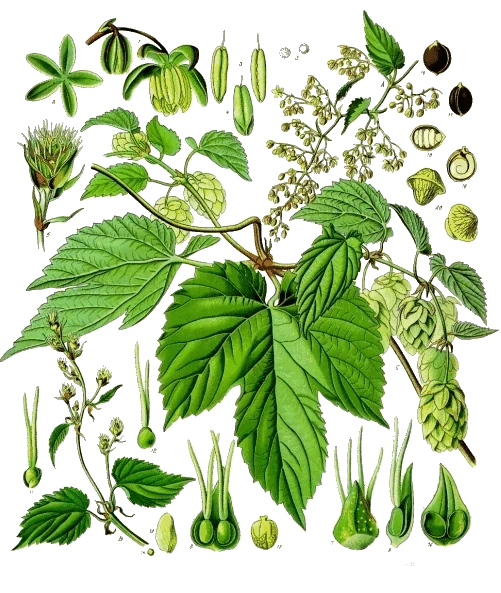
One of the signature terpenes in hops, part of the herbal, bitter character in beer, though myrcene drives most of the aroma.
Did you know?
You will often read that humulene curbs appetite instead of bringing on the munchies. We went looking for the study behind that and could not find one, so we treat it as folklore, not a proven effect. Its anti-inflammatory activity in animal studies is the better-supported story.
How it tends to land
Commonly reported as mellow and grounded. Tendencies, not promises. Your body writes the last word.
Pairs well with
Examined for these conditions
Where the evidence stands
Ranked by how much each finding can actually tell you, strongest first. A trial in people outranks a study in cells, including when the answer is no.
Animal studies
Anti-inflammatory activity
Reduced several inflammatory signals in the airways of mice. Notably humulene worked here where caryophyllene did not, which is a reminder that closely related terpenes are not interchangeable. Rogerio AP, Andrade EL, Leite DF, et al. (2009). British Journal of Pharmacology, 158(4). PubMed 19438512
Animal studies
Lowers COX-2 and iNOS expression
Oral humulene reduced swelling, TNF-alpha and IL-1beta, and lowered the EXPRESSION of COX-2 and iNOS in rats. Worth being precise here: reducing how much of an enzyme the body builds is not the same as blocking the enzyme itself, which is how aspirin and ibuprofen work. Different route to a similar place. In these models the effect was comparable to dexamethasone. Fernandes ES, Passos GF, Medeiros R, et al. (2007). European Journal of Pharmacology, 569(3):228–236. PubMed 17559833
No published study · still open
Suppressing appetite
On nearly every dispensary page, and in no study we could find. Searching across species turned up no research testing humulene against appetite or body weight at all.
Chemical identity, formula and molar mass: PubChem CID 5281520, National Center for Biotechnology Information.
Terpenology is educational, not medical advice. Terpene effects are tendencies commonly reported by patients and early research, never guaranteed outcomes. Work with your certifying physician and pharmacist.