
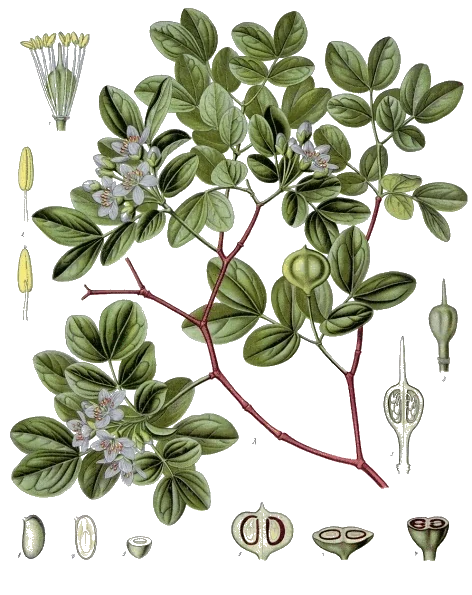
Pine, fresh wood, and a hidden rose. The rare terpene that’s a crystal at room temperature.
Worth knowing
Named for guaiacum resin, with centuries of traditional use; well characterized in natural-products chemistry.
Did you know?
Nearly every cannabis site lists guaiol’s boiling point as 92°C, and nearly every one is wrong: 92°C is its melting point, copy-pasted into the wrong column for years. Guaiol is a crystalline solid that actually boils near 309°C. It still reaches you from flower, carried out on steam with the lighter terpenes, so the “heat it low or it burns off” advice has the chemistry backward.
How it tends to land
Commonly reported as grounded and serene. Tendencies, not promises. Your body writes the last word.
Pairs well with
Examined for these conditions
No condition has research pointing specifically to this terpene yet. Browse all conditions
Where the evidence stands
Ranked by how much each finding can actually tell you, strongest first. A trial in people outranks a study in cells, including when the answer is no.
Guaiol is the thinnest evidence base in this Field Guide, and we would rather say so than dress it up. Searching for compound-specific research on guaiol turns up almost entirely studies of whole plant oils that happen to contain it, which can tell you about the oil, but not about guaiol. Where we describe guaiol, we are describing chemistry and aroma, not demonstrated effects.
Cell studies
Anti-parasitic activity in cell culture
Isolated guaiol killed a parasite in cell culture without harming the host cells, and modestly reduced one inflammatory signal. This is the one study we found that tests guaiol itself rather than an oil containing it. Garcia MCF, Soares DC, Santana RC, et al. (2018). Parasitology, 145(9). PubMed 29352826
No published study · still open
Antimicrobial and antioxidant activity
Commonly listed, including here until July 2026. Five separate literature searches turned up no study of guaiol itself for antibacterial, antifungal, general anti-inflammatory or antioxidant activity. Only whole-oil research, which can describe the oil but not the molecule.
Chemical identity, formula and molar mass: PubChem CID 227829, National Center for Biotechnology Information.
Terpenology is educational, not medical advice. Terpene effects are tendencies commonly reported by patients and early research, never guaranteed outcomes. Work with your certifying physician and pharmacist.