
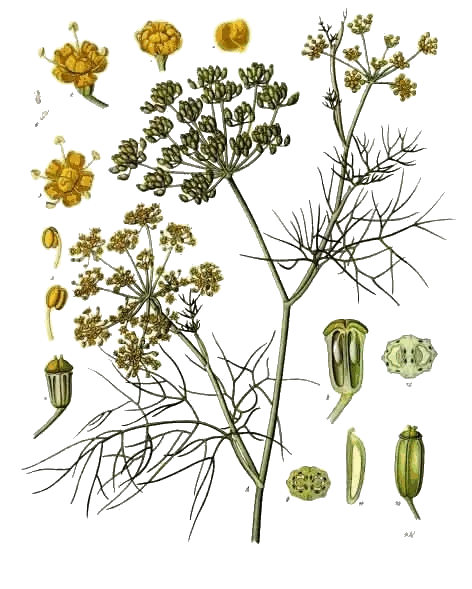
Fennel, pine, and a clean herbal lift. The licorice-family terpene your label may call by its other name.
Worth knowing
A monoterpene alcohol from basil, fennel, and pine, well characterized in perfumery.
Did you know?
A 2014 study found fenchol among the more potent monoterpenes at inhibiting TRPA1, a receptor involved in pain signaling, outperforming camphor and eucalyptol. Promising and early, and not yet studied in real cannabis use.
How it tends to land
Commonly reported as calm and herbal. Tendencies, not promises. Your body writes the last word.
Pairs well with
Examined for these conditions
No condition has research pointing specifically to this terpene yet. Browse all conditions
Where the evidence stands
Ranked by how much each finding can actually tell you, strongest first. A trial in people outranks a study in cells, including when the answer is no.
Published research calls this molecule fenchyl alcohol. Labels may print it either way.
Cell studies
Inhibits TRPA1, a receptor involved in pain signaling
Fenchol was among the more potent monoterpenes tested, inhibiting TRPA1 more than camphor or eucalyptol did. Two honest limits: borneol and 2-methylisoborneol also outperformed those two, so fenchol is not uniquely strong; and this is a cell assay, not pain relief measured in an animal or a person. Takaishi M, Uchida K, Fujita F, et al. (2014). Journal of Physiological Sciences, 64(1). PubMed 24122170
Chemical identity, formula and molar mass: PubChem CID 15406, National Center for Biotechnology Information.
Terpenology is educational, not medical advice. Terpene effects are tendencies commonly reported by patients and early research, never guaranteed outcomes. Work with your certifying physician and pharmacist.