
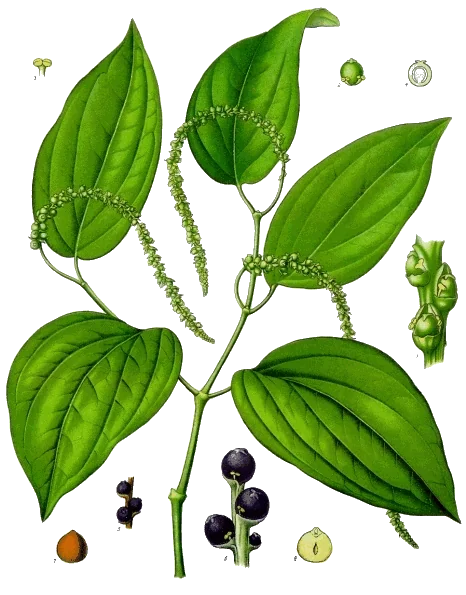
Peppery, woody, body-easing. The one terpene that doubles as a cannabinoid.
Worth knowing
The only common cannabis terpene that acts on a CB2 receptor, chemically a terpene, functionally a cannabinoid.
Did you know?
That old trick of chewing black peppercorns to ease too-much-THC jitters has real footing, pepper’s caryophyllene and THC meet at the same receptor. Commonly reported to help, harmless to try.
How it tends to land
Commonly reported as grounded and body-easing. Tendencies, not promises. Your body writes the last word.
Examined for these conditions
Anxiety and Panic/Attention-Deficit/Hyperactivity Disorder/Autism Spectrum Disorder/Cancer and Chemo/Chronic Pain/Crohn's Disease and IBD/Depression/Epilepsy and Seizures/Fibromyalgia/Lupus/Menstrual Health/Multiple Sclerosis/Neuropathic Pain/PTSD/Parkinson's Disease/Perimenopause/Rheumatoid Arthritis / See all conditions
Where the evidence stands
Ranked by how much each finding can actually tell you, strongest first. A trial in people outranks a study in cells, including when the answer is no.
Animal studies
Binds the CB2 receptor directly, a terpene that acts as a cannabinoid
A selective CB2 agonist (Ki 155 nM). Oral dosing reduced inflammation in normal mice but not in mice lacking the CB2 receptor, which is what ties the effect to that pathway. Gertsch J, Leonti M, Raduner S, et al. (2008). Proceedings of the National Academy of Sciences, 105(26):9099–9104. PubMed 18574142
Chemical identity, formula and molar mass: PubChem CID 5281515, National Center for Biotechnology Information.
Terpenology is educational, not medical advice. Terpene effects are tendencies commonly reported by patients and early research, never guaranteed outcomes. Work with your certifying physician and pharmacist.